A baby’s hearing plays an important role in developing speech, language and communication skills. When a newborn does not pass a routine hearing screening or a doctor has concerns about hearing development, a more detailed hearing assessment may be recommended. One such assessment is the Brainstem Evoked Response Audiometry (BERA) test, also known as the Auditory Brainstem Response (ABR) test.
If you are looking for a BERA test for babies in Ravet, understanding the procedure can help you prepare for your child’s appointment and know what to expect.
The BERA test records electrical responses along the auditory nerve and brainstem pathways when sounds are presented to the ears. It does not require a baby to speak or respond consciously, making it useful for assessing hearing in infants and young children.
In this guide, we explain why a BERA test may be recommended, how to prepare your baby, what happens during the test, how results are interpreted and what parents should do afterward.
What Is a BERA Test for Babies?
BERA is a specialised hearing assessment that measures electrical responses generated along the hearing pathway when sounds reach the ears.
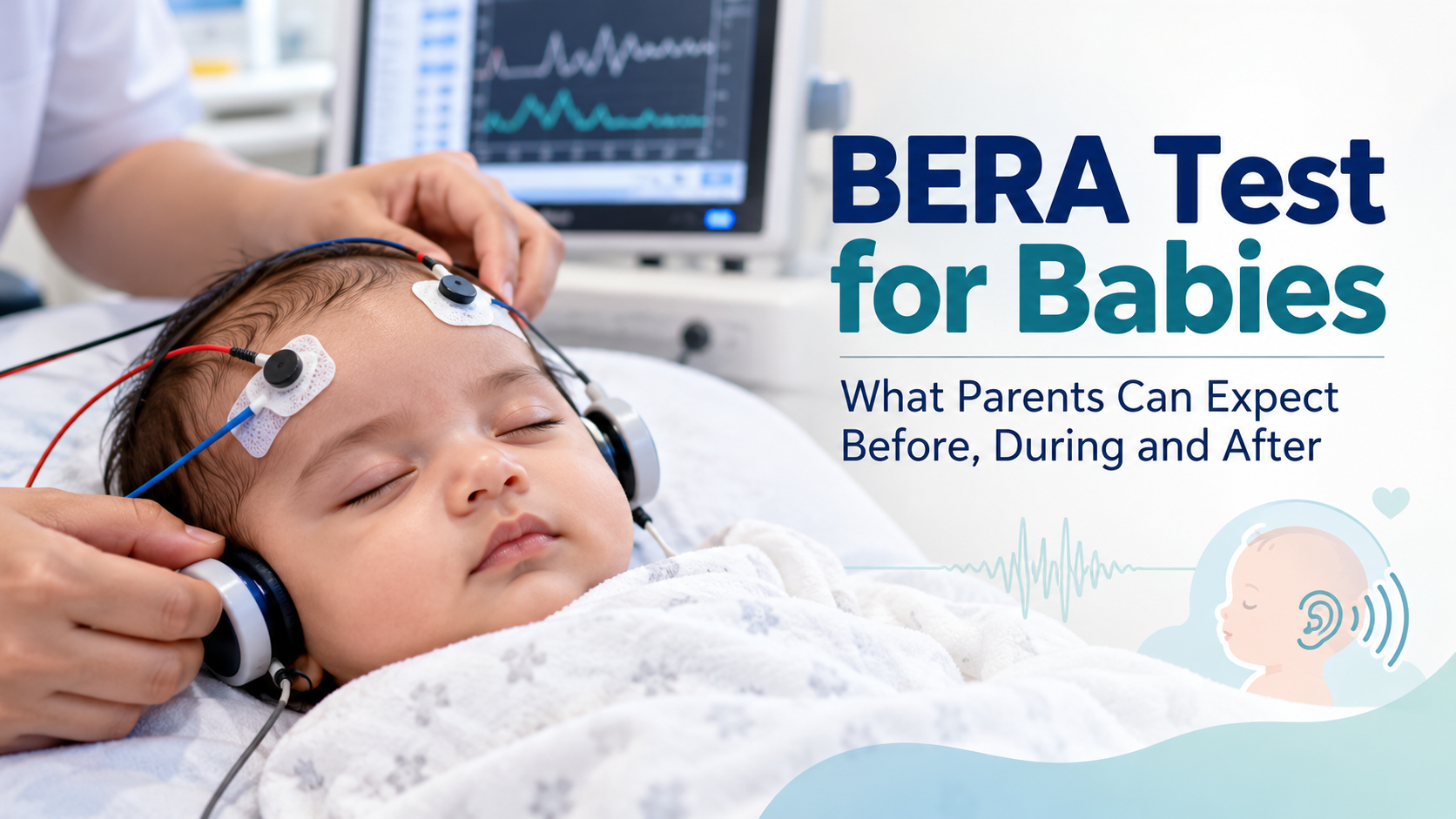
During the procedure, small sensors called electrodes are placed on the baby’s skin. Soft earphones or ear inserts deliver sounds, such as clicks or tones, while the equipment records the responses.
Unlike conventional hearing tests that require a child to respond to sounds, BERA can be performed while a baby is naturally asleep. The results help the audiologist assess hearing-related responses and determine whether further evaluation is necessary.
Learn more about hearing assessment services through the Madhurai Hearing website.
Why Might a Baby Need a BERA Test?
A doctor or audiologist may recommend a BERA test for several reasons.
- Unclear newborn hearing screening: The baby did not pass the initial hearing screening or the results were inconclusive.
- Concerns about hearing responses: Parents or healthcare professionals have concerns about the baby’s response to everyday sounds.
- Medical or birth-related risk factors: Certain medical conditions or birth histories may indicate the need for detailed hearing assessment.
- Further evaluation after screening: Additional testing is required to understand the baby’s hearing more accurately.
- Difficulty completing other hearing assessments: The baby is too young to participate reliably in tests that require a behavioural response.
A referral for BERA does not automatically mean that a baby has permanent hearing loss. Further assessment may be needed to understand the reason for an unclear or abnormal screening result.
Parents should ask the referring doctor or audiologist why the test has been recommended and what information it is expected to provide.
How Should Parents Prepare Their Baby for a BERA Test?
Preparation is important because the baby generally needs to remain asleep or very still during the recording. Movement can interfere with the electrical signals measured by the equipment.
The hearing-care team will provide instructions based on your baby’s age, health and the type of assessment planned.
1. Follow the Feeding and Sleep Instructions
For some infants, the audiologist may recommend scheduling the appointment around the baby’s usual feeding and sleeping routine. Parents may be asked to help the baby become naturally sleepy before testing.
Follow the centre’s instructions rather than deliberately keeping your baby awake for an extended period or changing the feeding routine without guidance.
2. Keep Your Baby Comfortable
Dress your baby in comfortable clothing and bring a familiar blanket if the centre permits it. Familiar items may help your baby settle during the appointment.
3. Follow Hair and Skin Preparation Instructions
The electrodes need good contact with the skin. You may be asked to bring your baby with clean, dry hair and without oil or heavy hair products.
Confirm the exact preparation requirements with the testing centre before your visit.
4. Bring Previous Medical and Hearing Reports
Carry the following documents, where available:
- Previous newborn hearing-screening reports
- Doctor’s referral letter
- Relevant medical records
- Details of any previous hearing assessments
These records help the audiologist understand your baby’s history and plan the assessment.
5. Ask Whether Sedation Is Required
Many young infants can undergo BERA testing during natural sleep. Some older or more active children may require a different plan if they cannot remain asleep or sufficiently still.
Sedation is not automatically necessary for every baby. If medication or anaesthesia is being considered, the medical team should explain the reasons, preparation requirements, monitoring and potential risks.
Never give your baby sleeping medication or a sedative without explicit medical instructions.
What Happens During a BERA Test?
Understanding the usual steps can help parents feel more prepared for the appointment.
Step 1: Initial Assessment
The audiologist reviews the referral, previous hearing-screening results and relevant medical history. The team may also examine the baby’s ears before beginning the test.
Step 2: Placement of Electrodes
Small sensors are attached to the baby’s skin, usually around the forehead and other specified positions on the head. These electrodes record electrical responses and do not deliver an electric shock.
Step 3: Sounds Are Presented Through Earphones
Soft earphones or ear inserts deliver clicks or tones into the baby’s ears. The equipment records responses from the auditory nerve and brainstem pathways.
The baby generally needs to remain asleep or very still so that movement does not interfere with the recordings.
Step 4: Recording and Interpretation
The equipment records waveforms that the audiologist analyses. Depending on the assessment, different sound levels may be tested to estimate hearing sensitivity.
The findings are interpreted alongside the baby’s medical history and any other relevant hearing assessments.
The exact testing procedure and duration may vary depending on the baby’s age, the type of BERA assessment and the clinical requirements.
Is the BERA Test Painful or Safe for Babies?
BERA is a non-invasive hearing assessment. Small electrodes are attached to the skin, and sounds are delivered through earphones or ear inserts.
The test does not require a surgical procedure or a conscious response from the baby. Some babies may become restless because they are in an unfamiliar environment or find it difficult to sleep.
If the baby moves frequently, parts of the assessment may need to be repeated to obtain reliable recordings.
When sedation or general anaesthesia is being considered, the associated risks and monitoring requirements differ from those of testing during natural sleep. Parents should discuss these details with the responsible medical team before proceeding.
How Long Does a BERA Test Take?
The duration depends on the type of assessment, the number of sound levels being tested and the baby’s ability to remain asleep.
Parents should allow enough time for preparation, settling the baby, completing the recordings and discussing the findings.
A detailed diagnostic assessment may take longer than a routine newborn hearing screening. Ask the centre about the expected appointment duration when booking.
How Are BERA Test Results Explained?
After the assessment, the audiologist reviews the recorded responses and explains what they indicate about the baby’s hearing.
The findings may suggest responses within the expected range at the tested levels, or they may indicate that further assessment is necessary. Interpretation depends on the test protocol, recorded responses and the baby’s clinical history.
Results Within the Expected Range
Results within the expected range can be reassuring for the hearing pathways and sound levels assessed. However, parents should continue to monitor hearing, communication and developmental milestones as recommended by their healthcare professional.
Abnormal or Unclear Results
An abnormal or unclear result does not automatically confirm permanent hearing loss. The audiologist may recommend repeat testing or additional assessments to understand the findings.
Differences Between the Two Ears
The assessment may identify differences in responses between the left and right ears. Further evaluation can help determine the significance of these findings and whether additional care is required.
A routine hearing screening and a comprehensive diagnostic BERA assessment are not the same. Parents should ask which test was performed, what the results mean and whether any further evaluation is recommended.
What Happens After the BERA Test?
The next steps depend on the findings and the reason the test was recommended.
- Discuss the report: Ask the audiologist to explain the findings in simple language, including any limitations.
- Complete recommended follow-up tests: These may include otoacoustic emissions (OAE), middle-ear assessment or additional hearing tests.
- Consult the appropriate specialist: An ENT specialist or paediatric audiologist may be involved if further investigation or treatment is required.
- Arrange appropriate support: If hearing loss is confirmed, the care team can discuss suitable hearing technology, communication support and early-intervention options.
- Continue developmental monitoring: Attend follow-up appointments and discuss concerns about your child’s response to sounds or communication milestones.
Timely follow-up is important because early identification of hearing difficulties can help families access appropriate support during language and communication development.
For information about available hearing-care services, visit Madhurai Hearing or contact the centre to enquire about assessment and appointment requirements.
When Should Parents Seek a Hearing Assessment for Their Baby?
Parents should discuss hearing assessment with their baby’s doctor if the child does not pass newborn hearing screening, receives an unclear result or has medical risk factors that warrant further evaluation.
It is also important to seek professional advice if you have concerns about your baby’s responses to sounds or later communication development.
A baby’s response to everyday noises alone cannot reliably confirm normal hearing. Do not delay a recommended follow-up appointment simply because your baby appears to respond to some sounds.
Choosing a Centre for a BERA Test for Babies in Ravet
When looking for a centre for a BERA test for babies in Ravet, consider the following factors:
- Whether the facility provides age-appropriate hearing assessments.
- Whether a qualified audiologist performs or interprets the test.
- Whether the team explains preparation and sleep-related instructions clearly.
- Whether the centre provides guidance about reports and recommended follow-up.
- Whether sedation, if considered necessary, is managed through an appropriate clinical protocol.
Parents can contact Madhurai Hearing to enquire about available hearing-assessment services, appointment requirements and whether a BERA test is suitable for their baby.
Frequently Asked Questions
1. Is BERA testing suitable for newborn babies?
Yes. BERA testing can be used to assess hearing in newborns and young infants. The audiologist determines the appropriate assessment based on the baby’s age, screening results and clinical needs.
2. Does my baby need to be asleep during the BERA test?
The baby generally needs to sleep or remain very still so that movement does not interfere with the recordings. Many young infants can be tested during natural sleep. Preparation requirements depend on the baby and the testing protocol.
3. Is sedation necessary for a BERA test?
No. Sedation is not necessary for every baby. Natural-sleep testing may be possible, particularly in younger infants. If sedation or anaesthesia is being considered, the clinical team should explain the reasons, risks and preparation requirements.
4. Does an abnormal BERA result mean my baby has permanent hearing loss?
Not necessarily. An abnormal or unclear result needs professional interpretation and may require repeat testing or other assessments. The audiologist will explain what the findings indicate and whether further evaluation is needed.
5. How should I prepare my baby for the appointment?
Follow the centre’s instructions about feeding, natural sleep, hair preparation and arrival time. Bring previous hearing reports and relevant medical records. Do not administer sleep-inducing medication without medical guidance.
6. Where can I enquire about a BERA test for babies in Ravet?
You can visit the Madhurai Hearing website to enquire about hearing-care services, test availability and appointment requirements.
Conclusion
A BERA test can provide important information about a baby’s hearing by recording responses to sound along the auditory nerve and brainstem pathways. Understanding the preparation, procedure and possible results can help parents approach the appointment with greater confidence.
If your baby has been referred for a BERA test, follow the audiologist’s instructions and complete the recommended follow-up. An unclear screening result is not a diagnosis by itself, and the appropriate next step depends on the complete assessment.
For parents searching for a BERA test for babies in Ravet, Madhurai Hearing is a starting point for enquiries about hearing-care services and appointment requirements.
Medical disclaimer: This article is for general educational purposes and does not replace individual medical advice. Consult a qualified audiologist or ENT specialist for guidance specific to your baby.